


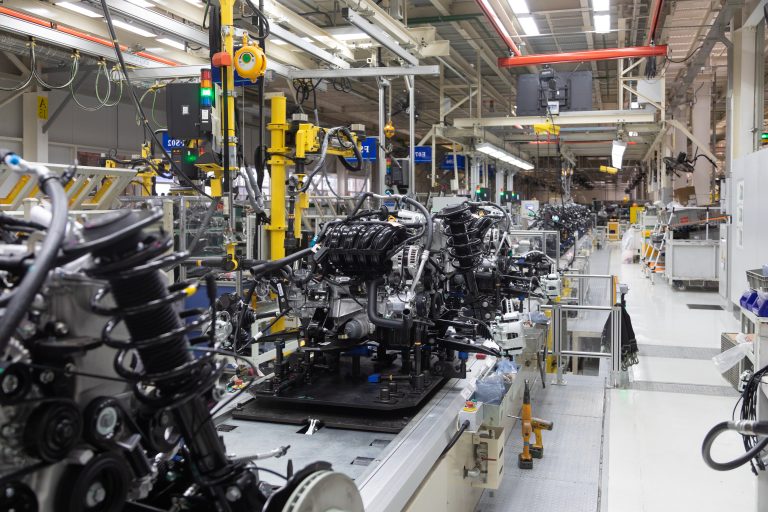
Turkish Automotive Industry
Loading...
According to the latest data, worldwide production reached approximately 92.5 million motor vehicles in 2024.
Loading...
Over 5,000 parts manufacturers are active, including global brands like Bosch, Continental, Denso, Visteon, Delphi, Johnson Controls, Bridgestone (via Brisa), Sumitomo Rubber, Pirelli, and Goodyear operating joint ventures in Türkiye. The sector invests heavily in CAD/CAM design, CNC machining, prototyping and collective R&D, geared toward EVs, autonomous technologies, sustainability, and energy efficiency.
Türkiye’s automotive sector ranks among the nation’s top export earners—with vehicles and components accounting for over 16 percent of total exports. In June 2025 alone, shipments hit a record US $3.4 billion, driven by strong European demand, especially Germany, which bought US $556 million worth (+74 percent YoY).
Türkiye’s automotive exports are heavily concentrated in Europe, accounting for nearly 80 percent of total shipments. In 2024, key markets included Germany (~18%), the UK (~10%), Italy (~8%), and France (~7%). While Europe remains dominant, Türkiye is diversifying: the US and Canada now absorb roughly 5%; Middle East & North Africa attract ~4%; and Sub‑Saharan Africa ~3%.
Türkiye is a leading vehicle exporter to the EU: in the latest period, EU imports from Türkiye comprised vans (€3.3 billion, +9.2 % YoY, holding a 52.6 % share), trucks (€383 million, –35.7 % YoY, 28.1 % share), and buses (€1.8 billion, –1.2 % YoY, commanding a 68.6 % share of EU bus imports).
Between 2016 and 2024, Türkiye’s automotive industry experienced significant fluctuations. Production peaked in 2017 at 1.696 million units before stabilising around 1.35–1.47 million in recent years. Exports followed a similar trend, dipping after 2018 but recovering to over 1 million units by 2024.
Türkiye offers a compelling mix of strengths in the automotive sector: a robust manufacturing infrastructure heavily clustered in the Marmara region (Bursa, Istanbul, Kocaeli, Sakarya) — backed by over 15 billion USD in OEM investments since 2000.
Türkiye’s current automotive production lineup features a diverse range of globally recognised models manufactured by leading OEMs.
Türkiye’s Automobile Joint Venture Group (TOGG) represents a landmark national initiative set to contribute $50 billion to the country’s GDP. The project is expected to create 5,000 direct and 20,000 total jobs, while delivering five electric vehicle models over a ten-year period, with a total production goal of 1 million units.
A strategic investment of $2 billion USD in electric and next-generation commercial vehicles is set to expand Türkiye’s automotive manufacturing capacity by an additional 200,000 units.
Toyota has invested $317 million USD to launch production of the new C-HR Plug-in Hybrid Electric Vehicle (PHEV)—marking the first plug-in hybrid passenger car manufactured in Türkiye.
Established in 2010 by the Uludağ and Automotive Industry Exporters’ Unions (UIB–OİB), the OİB Vocational & Technical Anatolian High School in Görükle, Bursa, was founded to address the sector’s skilled workforce needs.
The Türkiye Automotive Industry Sustainability Action Plan outlines a six-pillar roadmap for achieving a greener, more inclusive automotive sector.
End of content
No more pages to load